Monday, 2 May 2016

Ladybird Travel Adventure - your help needed

Introduction

A couple of weeks ago a journalist called Steve Clark got in touch.  He was thinking about writing an article about the real scenes captured in Ladybird Books.  Previously he had written a Ladybird-themed blog-post,  which I had shared on Twitter.

In Steve's blog post he had put side by side two pictures - one a photo of a village local to him which had been used as a basis to the front cover of the 1960s book 'The Little Red Hen'  and the other the picture from the book itself - a book beautifully illustrated by Robert Lumley.

The post attracted quite a lot of attention, as things often do that remind people of this much-loved series of children's books.  He wanted to turn it into an article for a Sunday paper - possibly the Mail on Sunday.  Now this is a topic that has interested me for a while.  I've been planning to write something on the topic and have been collecting pictures for this purpose for a while so I told him this.  However, in the spirit of Ladybird Land I agreed to help him with it and shared some of my information.

The story, due out 2 weeks ago, never appeared, he didn't contact me again and I assume that Steve changed his mind or, more likely perhaps, an editor was less enamored with the idea than either of us.

So now I shall share some of the scenes I have accumulated so far - mainly thanks to research and heavy use of Google Street view - but also thanks to contributions from some kind folk out there.

But I'd love to collect some more.  If you can place any well-known Ladybird scenes, I'd really appreciate your help.

1)  John Berry's Police Station from the 1962 version of 'People at Work - The Policeman' and Brixton Police Station today
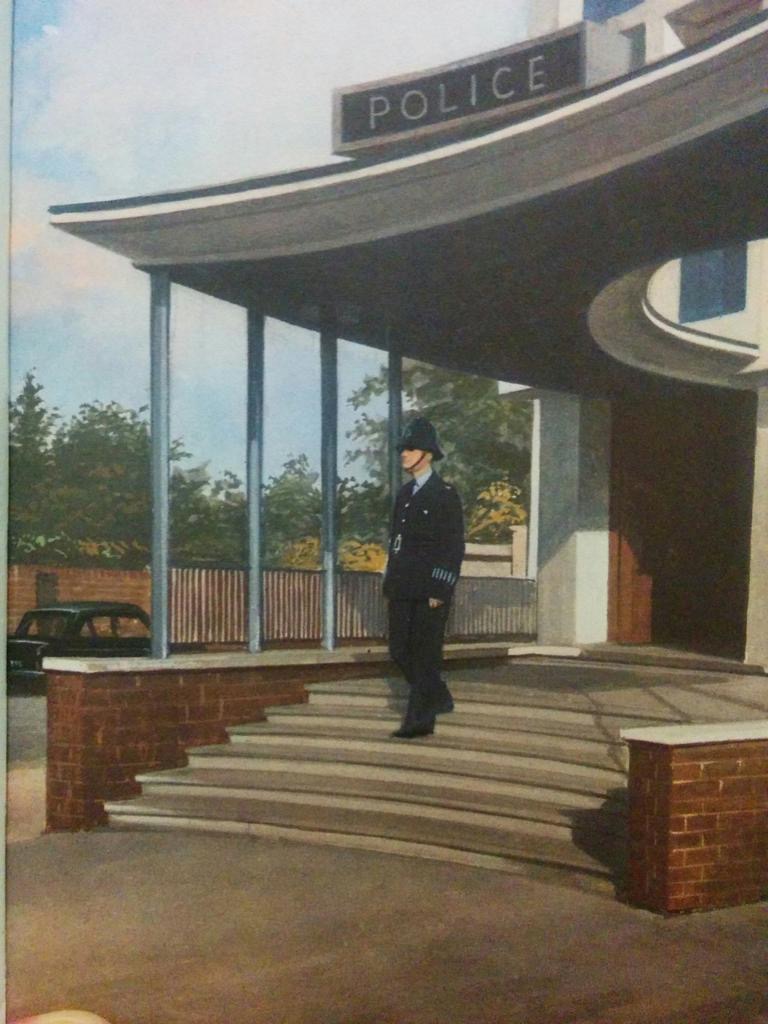


 via @lovesBrixton

The Wesleyan Methodist Chapel - adorned with cuddly Morris Traveller - from Robert Ayton's 1964 illustrations in 'Churches and Cathedrals' 


and today - now Bridport Arts Centre.

(Thanks to Gary Grant @ecoschemes)

3)Now on to London (John Berry again, 1961)

First we have The Royal Exchange in 1961:

(Apparently the flashy car in the foreground was John Berry's own - he squeezed a cameo of it into a few of his pictures)

And from Google: (very grateful to the bus for lining up so precisely).


The Science Museum, 1961 - hushed and tranquil


And today ... (ish)


Tower Bridge hasn't changed much of course, but the view behind it has.


(No, don't let the lean unsettle you; I don't think it's falling down in reality).


Some scenes have barely changed, of course:


The British Museum may have been completely revamped in some areas but others look much the same ...


I can't get quite the right picture of Piccadilly Circus - and not by night - but you get the idea.


London Zoo no longer seems to keep sea lions so the nearest I can get is the Penguin Pool


Though in my research I found the newspaper image that Berry seems to have based his painting on:
As for Heathrow,  ... (back in 1961 in was 'London Airport')


And today ...


4) But my favourite finds are still from fiction - there's an added buzz when a photograph hints that perhaps your five-year-old self wasn't wrong: perhaps after all it's all really really real and the ungrateful little gingerbread boy one day just might run past you ...


 And of course, let's not forget The Little Red Hen


Sunday, 6 March 2016

What's so special about ... John Berry (part 2)

(Part one is here)

As I said in my last post, the People at Work series was one of the first Ladybird series I remember.

The first 7 titles represent for me 'old Ladybird' - with a rather retro post-war comfort and solidity to them.  They show the grown-up world of work as a place of responsible adults, striving honestly to  make the world a safer or a more comfortable place for us all - particularly for children.   Nobody runs in this world - except the villains, and then the policeman (there are barely any policewomen) is forced to give chase.  But for the most part people walk placidly, or sit or stand.  All shall be well and all manner of thing shall be well in Ladybird Land.

 The policeman will catch the thief because that's what policemen do.  The fireman will put out the fire and the people will be safe. The nurse will look after the child and the child will soon be well again.  Even the battery farms are happy places, with contented hens (it says so in the text).

There a real sense of transition in the next batch of book that Berry illustrated in this series, all of which were issued in the late 1960s.  From The Postman to The Lifeboatmen this is very much a man's world.  In these books there are even fewer illustrations of women - not even as onlookers (with the notable exception of the workers in the potteries).

 In these books technology is very much to the fore and generally this is embraced with enthusiasm - particularly in the text.

The working world is still a noble place.  From the heavy industry of The Miner to the light industry of The Pottery Makers these are centuries-old trades, plied by workers much as they every have been - just with more buttons and levers.


The emphasis is on public service and great works. The three forces are covered in The Sailor, The Airman and The Soldier, all three men (just men) alert in their wholesome roles of peace-keepers and defenders.
Although they not actually in this series, the 3 books, also illustrated by Berry in a series called 'The Public Services,' really belong here - because of chronology and tone. (In case you've forgotten, the Public Services in question were Water, Gas and Electricity.  Remember now?  Seems a long time ago).

Basically, the late-60s is an exciting time to live - even if the colours are a little drab, a little dour at times compared to the earlier books.


The roads, freshly built by The Roadmakers are wide and smart and empty.  Daddy can drive his brand new Mini, crafted by 'The Carmakers', quickly down these roads, home to Mummy and a home powered by wonderful labour-saving devices.

The rapid rate of technological development is still a little disconcerting at times, but there are helpful men (always men) with neat partings and heavy glasses ever on hand to orientate us through it all.


There are pylons and power stations and maybe at times these are a little challenging in our mental and physical landscape.  But the pylons and power stations are not unharmonious; 
not without their own grandeur and grace.

(To be continued).


The 'People at Work' series, 606b, and 'Public Services', 606e, illustrated by John Berry and written by different authors - but mainly by I and J Havenhand

Friday, 29 January 2016

The great Ladybird Book charity sale


You've finally done it - you've got your hands on the very last book needed to complete your prized collection of Ladybird Books.  So ... now what do you do?

What one pair of collectors, Kate and Philip Morgan, have done is to donate the whole lot to a local Oxfam Bookshop to be sold off.

There are hundreds of books in this  collection  - probably over a thousand and altogether they must be worth thousands of pounds, as all the rare titles are all there (although not shown in the picture) and are mostly in great condition.  The couple built up the collection in the usual way - trawling through secondhand bookshops and charity shops for years and ending up getting "quite obsessive about it".  [Hmmm.  Wonder what that feels like ... ;-) ]


The Oxfam Bookshop in question is in Cirencester and they have decided, rather than putting them all up for sale online, to have a launch.  In terms of prices, the policy is to set them at a level which is fair to the charity but makes the books cheaper than you'd probably be able to find them if buying them online.


The launch date is 8th February 2016 so if you collect Ladybirds and are trying to complete a set; if you are looking for a rare one or if you would simply like the chance to buy a whole load of great condition vintage books all at once, confident in the knowledge that prices are fair, then try to be in Cirencester on Monday 8th.  If you live nowhere near, the books can be reserved by phone from the 8th Feb and paid for by credit card or cheque.

So ... if you can't come in person, a booklist of the older, rarer books will be available the night before: the 7th February from 6.pm .  When it's realeased I'll publish it here, and on my Twitter feed @lbflyawayhome and on the vintage Ladybird Book Facebook group.

HERE's the link to the book lists:
http://ladybirdflyawayhome.com/oxfamcirencester.htm

*Strictly from the 8th Feb onwards*, books can be reserved by phone. However reservations will only be held until 5.15pm on 8th Feb, by which time the book must be paid for, either:
  • by payment and collection in person on the day
  • or by phone credit/debit card payment
Postage will be charged - at Royal Mail recorded delivery standard rates.

To make a reservation, the customer can call Oxfam on 01285 658729 

But remember - don't do this before before 8th Feb.  
A great donation for a great charity and what a kind, generous act!  Philip and Kate Morgan,  I salute you.

[Postscript]
Thanks to the power of social media and the hard work of a few volunteers, the Ladybird Book sale was a huge success and made several thousand pounds for the cause.

Saturday, 12 December 2015

You can't make an omlette ...

The thing about Ladybird Books ... well, one of the things ... there are a lot of things ... but one of my favourite things about Ladybird Books is the way they capture domestic scenes in snapshot.  Details of 20th century daily life, insignificant at the time, can pack a particular zeitgeist punch because they  slip under our guard.

I recently posted a picture online of a tea table laid for a tea party.
It evoked lots of comments as people focused on the details on the table: the tea-cosy, the proportion of cakes to sandwiches, the home-made jam tarts (always either red or yellow and of indeterminate sweet taste) and the cellophane frill around the cake.

(In the era of The Great British Bake Off and Choccywoccydoodah many of us had forgotten that humble yet gaudy, fringed cellophane cake frill the jazzed up your party cake. It seems my family was not alone in using the same cake frill for years, carefully removing it as the cake was eaten and putting it in a kitchen drawer where it would shed small pieces of hard icing through the year until  next called on for  active cake service).
 Eggs are another example of the spirit of the times lurking quietly in domestic detail.  I eat eggs today; I ate eggs when I was little (in the late 60s).  But looking through Ladybird Books of the late 50s to early 70s it's clear that eggs today aren't what once they were. Eggs loomed larger in our lives.  Eggs weren't about mayonnaise or quiche or souffle or even omlettes.  They were about poached, boiled, fried or scrambled.  Particularly, if Ladybird artwork and my memory are correct, about boiled.

 Egg cups - every body had egg cups in their cupboard.  Most people had their own egg cup which was fiercely defended. (Perhaps it once came 'free' with your Easter egg?)  Timing eggs was important.  You knew the difference in consistency of a 4 minute egg or a 6 minute egg. Egg timers were mainly used for timing eggs - not for playing board games.  You knew, or thought you knew,  or knew ... whichever! ... that it was (or wasn't) healthy to go to work or school on an egg. 
Boiled eggs might be the centrepiece of a salad.


Then how did you keep your egg warm until its time had come?  You were invited to knit egg cosies, or to give egg cosies as presents.

And when you'd finished eating your eggs, egg boxes were the staple of Ladybird craft activity.


The egg is still with us - but the Ladybird artwork evidence suggests that its importance has waned.  Once the egg was something - majestic in its simplicity.  Now it's more likely to be an ingredient, among other ingredients, on a long list in a complex recipe.

Wednesday, 28 October 2015

What's so special about ... John Berry. Part 1

For me, John Berry is right up there with the very best illustrators.

Although I've always enjoyed his artwork, he is another of the Ladybird artists that I've grown into more as I've got older.  One reason is perhaps because his books are among the first Ladybirds I ever encountered - even before I started school.  I think we had a copy of The Fireman and The Policeman around the house - probably given to my older brother.


So those memorable illustrations of the Dixon-of-Dock-Green-esque bobby and the splendid crimson of the fire engines are such a fundamental a part of my early childhood that I never really gave them much of a thought.

The next John Berry books I met were probably those he illustrated for the first version of the Peter and Jane series.  Although the differences between the Ladybird artists who contributed to this series are glaringly obvious to me now, at the time I was unaware of the different hands at work. Now I'll get this bit out of the way early (because it pains me to say it) but Berry wasn't at his best painting children at play.


This is a bit of a basic problem when illustrating a children's reading scheme and is probably the reason why he only produced the artwork for 3 of the 36 books in the series.  Although for me now the charm of his illustrations for this series is in their very stiffness and formality, it probably didn't quite meet the exacting requirments of Editorial Director Douglas Keen, who preferred Wingfield and Aitchison's ability to blend realism with movement and imagination.

I'm speculating here, of course - but anyway there was no lack of Ladybird illustration work for Berry at this time.  Much more up his street was the People at Work series that he alone illustrated, between 1961 and 1972.


In terms of social history this series may be unique in its documentation of the world of work in the second half of the 20th century, and contemporary attitudes towards it. Not only have some key professions been captured in the stunning photorealism of Berry's artwork but so much can be inferred by the emphasis of the books, what was selected, what was omited and what was updated.

For me, in terms of tone and outlook, the series breaks into two parts: the books produced before 1965 and those produced between 1965 and the end of the series in 1972 and I aim to look at these separately.


For now though, let me me sum up why I now find John Berry's artwork breathtaking. Yes, his technical ability was extraordinary.  Yes, he could paint factories, machinery and architecture with photographic precision but that alone wouldn't make an artist great.  Now I'm no art critic or art historian and, if you know about this stuff, you're going to have to be tolerant of me when I mangle concepts and use the wrong terms.  But for me Berry could compose and interpret a scene with small choices and small touches that set the final piece on a different plane, while making the process seem effortless. In addition to this, there's his versatility that I find baffling.


While I'm sure there are other artists who share a similar ability to paint a turbine or the manufacture of a ship's hull and make it look interesting - beautiful even - there must be far fewer who could then turn around and paint a soft, nostalgic landscape or produce empathetic, keenly observed portraits of the workers.  And all within the time and financial restraints of a busy editorial schedule and the requirements to produce twenty-four full pictures for every book.

In my next post I'll look in more detail at the first books in this series: The Policeman, Nurse, Fireman, Builder, Farmer and Fisherman.  after that I'll look at the later 'Work' books and other series he illustrated for Ladybird.

But in the meantime, here's a brief biography in the form of Cressida Connoly's excellent piece written shortly after Berry died in 2009

John Berry

Thursday, 17 September 2015

I am Sparticus

Something I find fascinating is when photographs come to light that were used by Ladybird artists as studies for their artwork.

Here's one that appeared on Twitter (via @russellsdesk) a couple of months ago - along with the image from the John Berry-illustrated Peter and Jane book that it appeared in:

What's the fascination?  Well I suppose it's a combination of things.  On the one hand it's the juxtaposition of fact and fiction and on the other it lays bare the great skill of the artists so that you can appreciate the choices made: what was retained, what was left out and what was adapted.  Of course, it also helps you 'go back stage' - to imagine the situation when the photograph was taken.  Who are the children in the picture? How did they feel? Was the boy fed up to be immortalised petting what appears to be a toy rabbit?  Did they realise at the time how iconic some of these images would turn out to be for so many of us?  Actually I can answer that last question: certainly not.


I know a bit about this because over the years quite of few of these early picture 'models' have contacted me.  Also, as the good folk at Penguin always say, if they ever organise some sort of Ladybird event they are sure to find that there are, apparently, half a dozen 'Peters' or 'Janes' in the room.

Why are there so many people around who believe that they are "the original Peter" or "the original Jane"?
Christophe Edward modelled for the book 'Helping at Home'
Well first of all, those two names are so synonymous with Ladybird that, although they only appear in  the 36 books of the Key Word Reading Scheme, the names tend to get bandied around to describe any pre-pubescent child in any Ladybird Book.


Artist Robert Ayton's nephew poses for the tin can telephone


Secondly about 5 different artists were involved in the illustration of just the reading scheme alone and their production covered roughly a 15 year period so many different children were asked to pose for preparatory sketches or photos as a part of this process.

Adrian Heath - one of the 1970s 'Peters'


But in these surviving preparatory photos we have the flash-bulb moment - the moment when normal children, whoever they are and how many of them there are, become Ladybird characters.