Friday, 29 June 2012

Puffin Picture Books

Why did Ladybird become so successful through the 1950s and 60s?

With the steer of Douglas Keen, Ladybird began to commission more and more non-fiction titles.  These titles clearly filled a gap in the educational market and I have read articles that imply that Ladybird were unique in their offer to this sector.  But recently my husband came back from a car boot sale and produced some Puffin Picture Books, which I found intriguing.

The titles looked very similar to Ladybird titles, they seemed to have the same market in mind and the dates were much earlier than I had realised - one of them, published in 1946) even pre-dating Ladybird's venture into non-fiction.

In the picture above you can see 3 Puffin Picture Books and their (later) Ladybird equivalents.  Clearly when Ladybird came along, Puffin was already  occupying the space in the publishing market - non-fiction for children - that was to be dominated by Ladybird for the subsequent few decades.  And they cost less money - between 1 and 2 shillings.

So then, why did Ladybird go on to achieve such phenominal success - leaving Puffin to move across and to focus mainly on the fiction paperbacks, overseen by Kay Webb, that I remember so vividly from a 1960s/70s childhood?
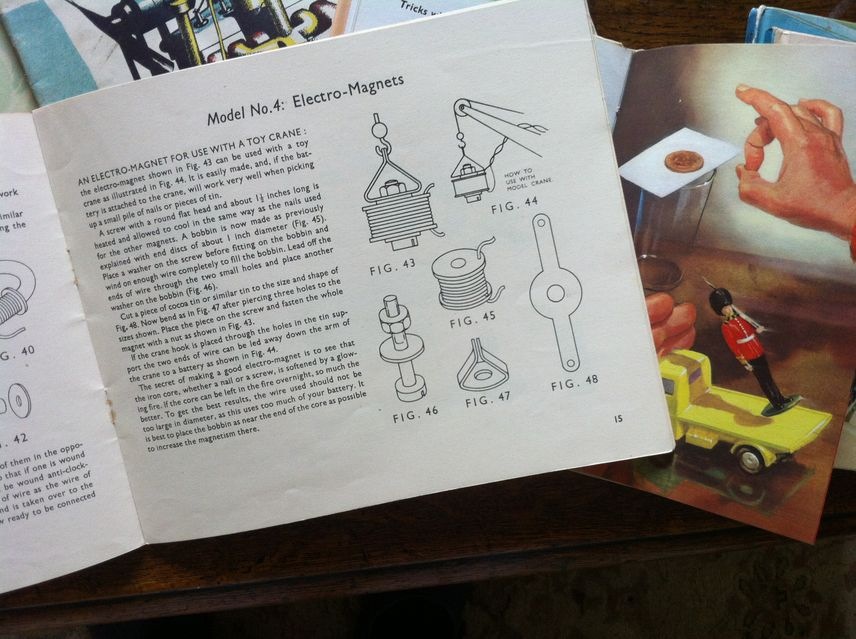
I think the answer becomes clear when you open up one of the Puffin Picture Books.

Although there are some colour pictures in the Puffins - the primacy and attractiveness of the Ladybird illustrations is of quite a different order - as you can see from the picture on the right: one from "Electric Models from Odds and Ends" and one from the Ladybird Junior Science series.

It's all about the artwork.

Wednesday, 23 May 2012

Lists


How often does the back cover of a Ladybird Book show that it has been as a tick list by a young owner, at some time in its life?

Book vandalism, of course. But then the Ladybird Book collector should be one of the first to admit to enjoying the pleasure of ticking off the books so far acquired in a given series. I've always thought that, because the books come in series, the need to 'complete a set' is the way most of us get sucked into hard core Ladybird collecting! (Hmmm. 'Hard core Ladybird collecting' ... has that combination of words ever before been used in the English language?)

So if you set yourself the task of collecting all or some series, how do you know which books you need? The list of titles on a DJ flap or the back of a Ladybird Book are a helpful pointer, but they often don't tell the whole story. Of course they don't tell you the books that were published after that title, about books that have multiple editions - and about titles that were no longer in print at that point - so you won't find a Nature series book published after then 1970s that mentions the first 3 books in that series (British Birds and their Nests) etc.

Once upon a time there was a fairly definitive list on Nick Robinson's Easy-On-The-Eye site. But that sadly seems no longer to be there. Nicole's list of all Ladybird Books is almost too comprehensive to be used as a check-list. The lists on my Bookshop pages are fairly comprehensive but aren't suitable to be printed out and shoved in your bag for the next time you visit a charity shop or car boot sale.

What I'd like to offer on my website is an easy-to-print definitive list of books between 1940 and, let's say, 1985. I'd also like to make it so that it would have 'tick boxes' that it could be selected/de-selected from a smartphone.

But can anyone help me get started? Has anyone got on Word or Excel a fairly comprehensive listing in chronological order that I could then adapt? If you have, and don't mind sharing, then please let me know.

Monday, 16 April 2012

When is a Ladybird Book ...


One of my nerdy pleasures in life is when someone contacts me and asks me if I can help them to identify a book that they remember from childhood. I'm often only given fragments to piece together - they might describe a picture from one of the pages, the first line of a verse or one of the characters. Sometimes these fragments have been mixed up over the years in the memory - adding to the complexity of the task. But I usually get there in the end.

To make matters worse though, sometimes people will describe a book to you and swear blind that it was a Ladybird Book - only quite clearly it wasn't. As Ladybird's success grew and grew through the 1950s and 1960s, other publishers jumped on board and attempted to emulate the success by copying the size and layout of the books. One of the main culprits here are 'Jack and Jill' Books (Fleetway).

You have to look pretty closely to realise that a Jack and Jill book isn't a Ladybird from the early 1960s - the format is almost identical. They had buff boards with a mono-colour line drawing on the front inside a full colour dustwrapper.

The price (2/6) is written on the inside of the front DJ flap and other Jack and Jill titles are listed on the back DJ flap.

I've collected quite a few of them over the years just so I could keep a record of the titles in the series. That way I know what that when someone asks me why they can't find a copy of "A Medal for Spangles" or "Pixie Pip at the Fair" for sale on my website, I know it's another case of Ladybird impersonation!

I meant to finish this post by listing all the Titles (16 - 20 from memory)in the J&J series. But I seem to have packed them away somewhere in my last attic tidy up. So if anyone has the set, feel free to add a comment.

Tuesday, 13 March 2012

Before She Was Mine


I'm currently reading a great book at the moment - Before She Was Mine, by Kate Long.


I love all of Kate's books anyway, but for a Ladybird Book lover, there's often an additional motivation: spot the Ladybird Book reference.

A fan of Ladybird Books herself, I've noticed there's often a sneaky reference to a Ladybird Book or two in Kate's novels.

So here's a new Spring challenge for you. Enjoy an uplifting book and play hunt the reference, at the same time.

I also see there's an article on Kate in the Mail today - although she has unaccountably failed to fit in a LB reference into this piece!

Wednesday, 1 February 2012

Party Games


Did you see those packs of vintage Ladybird postcards that were on sale around Christmas? I was, of course, tempted by them but then the obvious question was 'Why?'. I mean, what do you do with a box of Ladybird postcards?

Well here's an answer. Why did I never think of it? It came in an email I received this week from a Ladybird-loving friend.


We had a jolly Ladybirdy Christmas, especially on Boxing Day at my sister's.

I'd given her the Box of 100 Ladybird Postcards (yet another spin-off, postcard sized reproductions of the covers) and her lot decided they were going to play Charades with them, as in: take a card, hide it, mime the title to the rest of the party, they have to guess it.

High point was my 27 year old nephew, 6'5", being 'Bunnikins Picnic Party'; low point was me getting landed with 'The Public Services: Gas'. I will leave it to your imagination - wine had been taken. (Maybe a new feature of your website could be suggestions for party games that can be played with Ladybirds, the ruder the better?) They didn't guess my 'Come to Holland' which was very disappointing, I thought the windmill, and little-boy-with-finger-in-the-dyke mimes were excellent.


So there you go? New section for my website? Any more such inspired party-game suggestions?

Monday, 23 January 2012

Christmas Quiz 2011 Winner

And this year's winner is ...
Sangitha Vineeth - who sent her screenshot from India, with a day of my opening the quiz.

Sangitha, if you want to send me your address, I'll post you your prize (but don't hold your breath with excitement!)

Sunday, 18 December 2011

Notebooks


The company Ladybird, having taken a number of years to feel anything but embarrassment about the National Treasure status of old Ladybird Book imagery, has had a volte-face. In the last few years, especially at Christmas, an increasing range of nostalgia-fest products have been for sale: jigsaws, mugs, lunch-boxes, pencil-cases etc. Notebooks have been one of the more affordable products - Ladybird Book-proportioned soft-back notebooks (like the Shopping With Mother one above) destined for the Christmas stockings and the scribbles of the nostalgic baby-boomer.

Recently another sort of Ladybird notebook has appeared at Hertfordshire craft fairs this winter. These are actual old Ladybird Books which have been operated upon - they've been unbound, had the covers removed and then been re-bound with a strong spiral coil, and with the pages interleaved with blank pages.

Assuming the original books had major flaws - no spine, missing pages etc - I like the idea of re-purposing them in this way. You can buy these books (not just Ladybird Books but a range of others too) at this website:

Always assuming ...